
Side effects after a GLP-1 shot: when they happen, how long they last, what helps

Photo: Julia Topp / Unsplash
The prescribing information for Ozempic, Wegovy, Mounjaro and Zepbound says the same thing in different words: stomach and gut side effects are the most common ones, and most reports came while the dose was being stepped up. None of the labels gives a timetable by day after the shot. Your own log can.
The most common side effects
Each US label lists the side effects that came up more often on the medicine than on placebo in the clinical trials. For all four, the top of the list is the stomach and gut:
- Ozempic (semaglutide): nausea, vomiting, diarrhea, abdominal pain and constipation.
- Wegovy (semaglutide): nausea, diarrhea, vomiting, constipation and abdominal pain, followed by headache, fatigue and others.
- Mounjaro (tirzepatide): nausea, diarrhea, decreased appetite, vomiting, constipation, dyspepsia (indigestion) and abdominal pain.
- Zepbound (tirzepatide): nausea, diarrhea, vomiting, constipation, abdominal pain, dyspepsia and injection site reactions, followed by fatigue and others.
The numbers differ between medicines because the trials differ: Ozempic and Mounjaro were tested in people with type 2 diabetes, Wegovy and Zepbound in people with obesity or overweight, at different doses. Read the table below as "what each label reports", not as a ranking.
| Label, dose | Nausea | Diarrhea | Vomiting | Constipation |
|---|---|---|---|---|
| Ozempic 1 mg | 20.3% (6.1%) | 8.8% (1.9%) | 9.2% (2.3%) | 3.1% (1.5%) |
| Wegovy 2.4 mg | 44% (16%) | 30% (16%) | 24% (6%) | 24% (11%) |
| Mounjaro 15 mg | 18% (4%) | 17% (9%) | 9% (2%) | 7% (1%) |
| Zepbound 15 mg | 28% (8%) | 23% (8%) | 13% (2%) | 11% (5%) |
Placebo in brackets. Ozempic: Table 1; Wegovy: Table 3; Mounjaro: Table 1; Zepbound: Table 1 of each label.
When they happen
All four labels point to the same period: the dose escalation, the weeks when the dose is being stepped up.
- Ozempic: "The majority of reports of nausea, vomiting, and/or diarrhea occurred during dose escalation."
- Wegovy: the stomach and gut reactions "were most frequently reported during dosage escalation."
- Mounjaro and Zepbound: the majority of nausea, vomiting and diarrhea "occurred during dose escalation and decreased over time."
That is also why every one of these medicines starts at a low dose and goes up in steps: each label says the escalation is there to reduce the risk of stomach and gut side effects. The steps are explained in GLP-1 dose schedules.
What about the day after the shot? None of the four labels breaks side effects down by day of the week after an injection. If you want to know whether your own harder days fall on a particular day, the only source is your own record: count shot day as day 0 and note how you feel on each day after it, for a few weeks.
How long they last
The labels don't give a number of days. What they do say:
- For Mounjaro and Zepbound, nausea, vomiting and diarrhea decreased over time in the trials.
- Some people stopped treatment because of them. In the Wegovy weight-reduction trials, 4.3% of people on Wegovy stopped because of a stomach or gut side effect, against 0.7% on placebo.
- Severe stomach and gut reactions were reported too, and they have their own warning in every label.
The NHS advice for semaglutide and tirzepatide is to speak to a pharmacist or doctor if side effects bother you or don't go away. The Ozempic Medication Guide adds that diarrhea, nausea and vomiting can cause dehydration, that it is important to drink fluids, and to tell your healthcare provider right away about nausea, vomiting or diarrhea that does not go away.
What may help with nausea
The NHS page on feeling sick lists general things that may help. They are not specific to GLP-1 medicines, but they are where the NHS starts:
- eat smaller, more frequent meals, and don't eat too quickly;
- take regular sips of a cold drink, and don't have a large drink with meals;
- ginger or peppermint tea, or foods containing ginger;
- avoid hot, fried or greasy food, and strong-smelling food;
- don't lie down soon after eating, and avoid clothes that are tight around your waist;
- fresh air, and something to distract you.
The NHS medicine pages for semaglutide and tirzepatide also say it is best not to drink alcohol, because it can make feeling or being sick worse.
What may help with constipation
From the NHS constipation page, again general advice rather than GLP-1 specific:
- drink plenty of water and other fluids, and avoid alcohol;
- increase the fibre in your diet gradually, for example with wheat bran, oats or linseed, and fruit such as apples, apricots, grapes, raspberries and strawberries;
- keep a regular time for the toilet and don't delay when you feel the urge; resting your feet on a low stool can help;
- move more: the NHS mentions a daily walk or run.
The NHS counts it as constipation when you haven't had a poo at least 3 times during the last week, or you're going less often than usual. Its advice is to see a GP if constipation isn't getting better with treatment, if you notice blood in your poo, or if you have tummy pain, and to speak to the GP before you stop taking any prescribed medicine.

When to call your doctor
- Severe pain in your stomach area that will not go away, with or without vomiting, sometimes felt through to your back: the Ozempic Medication Guide says to stop using it and call your healthcare provider right away, because this can be pancreatitis. The other three labels carry the same warning.
- Nausea, vomiting or diarrhea that does not go away, because of the risk of dehydration and kidney problems.
- Stomach problems that are severe.
- Swelling of the face, lips, tongue or throat, or problems breathing or swallowing: get medical help right away.
In the UK, the NHS says to call 111 if you think you are having serious side effects. In an emergency, call your local emergency number.
Find your own pattern
The labels tell you what is common across thousands of people. They can't tell you which day of your week tends to be hard, or whether it changed after your last dose step. A simple log can: shot day as day 0, then one line a day for nausea, constipation, appetite and anything else you notice. After a few weeks, lay the weeks on top of each other and look at the same day in each.
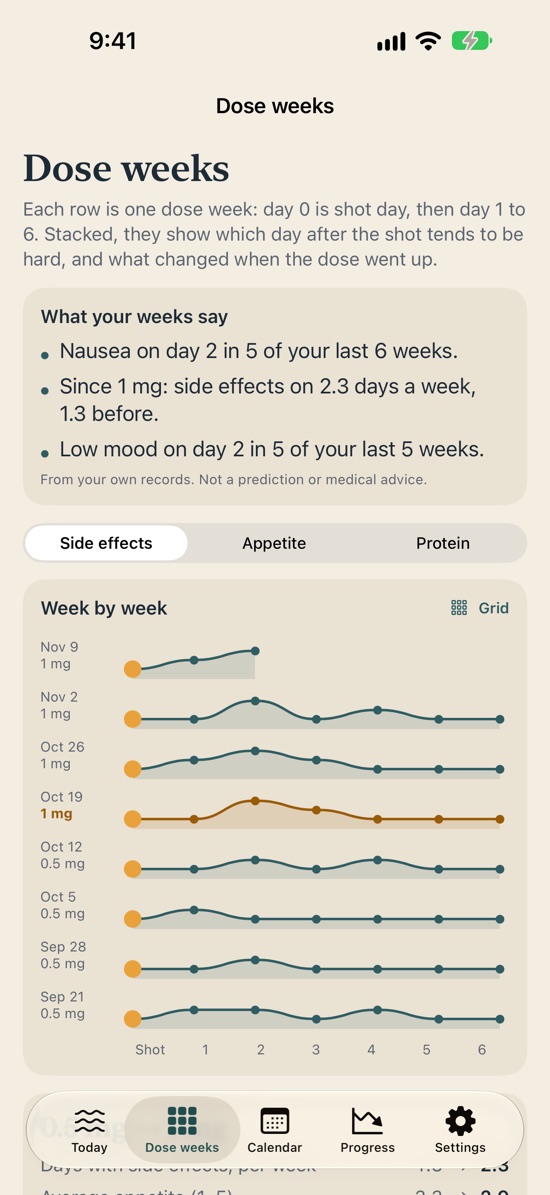
Take that record to your next appointment. It turns "I feel bad some days" into "day 2, in 5 of the last 6 weeks", which is something you and your prescriber can work with.
This page is general information from the sources below, not medical advice. Always follow your prescriber and the leaflet that comes with your medicine.
- Ozempic (semaglutide) injection: US Prescribing Information and Medication Guide, Novo Nordisk, revised 05/2026 (sections 5.7, 6.1, Table 1; Medication Guide), checked 20 November 2026.
- Wegovy (semaglutide) injection and tablets: US Prescribing Information, Novo Nordisk, revised 06/2026 (section 6.1, Table 3), checked 20 November 2026.
- Mounjaro (tirzepatide) injection: US Prescribing Information, Eli Lilly, revised 11/2026 (section 6.1, Table 1), checked 20 November 2026.
- Zepbound (tirzepatide) injection: US Prescribing Information, Eli Lilly, revised 11/2026 (section 6.1, Table 1), checked 20 November 2026.
- NHS: Feeling sick (nausea), checked 20 November 2026.
- NHS: Constipation, checked 20 November 2026.
- NHS: Semaglutide and NHS: Tirzepatide, checked 20 November 2026.